Featured Dimming & Hazardous-Area LED Solutions for Mexico City
Engineered in our Yueqing manufacturing center for international distribution across North America. Fully compatible with Mexican 127V/277V/480V 60Hz utility grids and smart automation retrofits.

300/600/1200mm 18-60W LED Ceiling Panel Light

20-50W Round Mini Explosion Proof Ceiling Light

30-50W Rectangular Explosion Proof LED Flood Light

10-24W AC85-265V 120lm/W Explosion Light
Industrial & Logistics Dynamics Across the Greater Mexico City Metropolitan Area
Mexico City (CDMX) and its surrounding industrial ring in the State of Mexico (Estado de México) represent the epicenter of Mexican commercial warehousing, automotive assembly, consumer goods distribution, and advanced manufacturing. Understanding its technical parameters is vital for robust procurement.
Cuautitlán, Tultitlán & Tepotzotlán (CTT Logistics Axis)
Handling over 65% of all dry-goods, retail, and e-commerce freight moving through central Mexico, CTT logistics facilities feature 12-to-16 meter high-clearance ceilings where standard fixtures create massive lighting dark zones. Automated microwave dimming luminaire arrays reduce static load while ensuring rapid LUX response for automated guided vehicles (AGVs) and forklift teams.
CFE Commercial Tariffs & Peak Demand Surcharges
Commercial power provided by the Comisión Federal de Electricidad (CFE) under the GDMTH (Gran Demanda en Media Tensión Horaria) tariff structure levies heavy peak charges. Intelligent bi-level sensor dimming cuts base load by up to 72% in intermittently accessed corridors, providing capital payback within 11 to 14 months.
Seismic Vibrations & Structural Resilience
Sitting in a lacustrine basin prone to seismic amplification, Mexico City structures endure continuous low-frequency mechanical stress. Traditional light bracket tabs fatigue rapidly. Our luminaires are engineered with vibration-dampened dual-point suspension fixtures, IK08/IK10 polycarbonate diffusers, and spring-loaded internal driver mounts.
The Shift from Passive Infrared (PIR) to Integrated Microwave Doppler Sensing
Industrial operators across Vallejo, Naucalpan, and Iztapalapa are actively decommissioning legacy PIR detectors. In warm, high-humidity manufacturing plants, ambient temperatures often approach human skin temperature (34°C), blinding PIR sensors and creating severe operational hazards.
Microwave Doppler Radar vs. Traditional Infrared: The Technical Edge
Our luminaires utilize 5.8GHz C-band high-frequency microwave radar sensors embedded directly behind the polycarbonate diffuser. The sensor emits low-power electromagnetic pulses, analyzing frequency shifts via the Doppler effect. Because the sensor does not rely on thermal differentials, detection accuracy remains absolute from -25°C in cold storage rooms up to +55°C in foundry operations.
Furthermore, high-frequency radar waves penetrate non-metallic materials such as thin plastic shelving, cardboard cartons, and fiberglass conduit, enabling a 360-degree detection cone across up to a 15-meter diameter without external lenses that collect oil, dust, and particulate matter.
| Functional Parameter | Legacy PIR Sensing Fixtures | Scoden Microwave Doppler Sensor Lights | Operational Impact for CDMX Facilities |
|---|---|---|---|
| Thermal Sensitivity | Severely degraded above 30°C ambient | 100% immune to ambient temperature shifts | Zero false triggers in unconditioned warehouses |
| Optical Contamination | External Fresnel lens soils rapidly | Fully concealed within IP65/IP66 enclosure | Zero maintenance cycles in dusty manufacturing |
| Detection Geometry | Line-of-sight cone (80° - 100°) | Multi-directional volumetric bubble (360°) | Eliminates blind spots in high-bay narrow aisles |
| Dimming Protocol | Step-switching (On/Off binary cycle) | Continuous 0-10V or DALI-2 smooth ramp | Extends LED driver lifespan by preventing inrush shock |
| Standby Power Logic | 0.8W - 1.5W idle sensor drain | Ultra-low < 0.3W integrated sensor standby | Critical compliance with NOM-031-ENER standards |
Key Challenges Facing Global Importers & CDMX Project Contractors
International EPC contractors, supply chain managers, and regional electrical distributors encounter three recurring roadblocks when sourcing industrial sensor lighting from overseas manufacturers.
Rigorous NOM Compliance & Custom Clearance Barriers
Importing into Mexico requires strict adherence to NOM-003-SCFI (safety of electrical products) and NOM-001-SEDE (electrical installations). Incomplete technical datasheets, missing test laboratory certificates, or incorrect Spanish-language labeling lead to immediate customs impoundment at Manzanillo or Lázaro Cárdenas ports. We deliver turn-key documentation audited by ISO/IEC 17025 accredited bodies.
Utility Grid Volatility & Severe Surge Environments
The Metropolitan Zone of the Valley of Mexico (ZMVM) experiences heavy electrical transients due to intense seasonal lightning storms from May through October and switching spikes from heavy industrial neighbors. Low-cost drivers fail within months. Scoden incorporates dual-stage 4kV/6kV/10kV surge protection devices (SPDs) and universal wide-voltage inputs (AC 100-277V / 347V).
Nearshoring Turnaround & SKD Assembly Flexibility
With multinational brands relocating production to central Mexico under nearshoring initiatives, lead times cannot tolerate delays. We maintain automated punching, glue-dispensing, and SMT lines in Yueqing, supplying finished OEM luminaires or Semi-Knocked-Down (SKD) kits to enable local Mexican integration, reducing tariffs while satisfying domestic content thresholds.
Industrial Luminaire Architecture: Tri-Proof & Hazardous Sensor Integration
How Scoden combines optical, electrical, and thermal engineering to build lighting that withstands corrosive industrial atmospheres, chemical fumes, and heavy particulate loads.
Hermetic Ingress & Corrosion Protection
Our fixtures utilize continuous foamed silicone polyurethane gaskets applied by CNC automated dispensing machinery. This achieves an inviolable IP65/IP66 seal against high-pressure water jets and acidic air pollution prevalent in heavy industrial zones. The housing is molded from flame-retardant, UV-stabilized virgin polycarbonate or copper-free ADC12 die-cast aluminum finished with electrostatic architectural powder coating.
- Gas Group Rating: Class I, Div 2 / Zone 2 compliant variants for paint spraying, solvent bays, and petrochemical depots.
- Impact Resistance: Certified IK08 (5 Joules) to IK10 (20 Joules) mechanically reinforced against direct projectile impacts.
- Chemical Resistance: Inert against alkalis, mineral acids, oils, and industrial cleansers.
Autonomous Multi-Step Dimming Engine
Each luminaire houses an intelligent control circuit programmed via remote dip switches or infrared commission controllers. Field engineers can set exact operational profiles without climbing boom lifts or dismantling fixtures.
- Detection Area: 100%, 75%, 50%, or 25% sensitivity to prevent adjacent row triggering.
- Hold Time: 5 seconds up to 30 minutes before stepping down to low-power standby mode.
- Standby Dim Level: 10%, 20%, 30%, or full shutdown for emergency stairwells or parking structures.
- Daylight Harvesting: Integrated photodiode locks out luminaire operation when skylight levels surpass 50 LUX.
Factory Verification, Testing Darkrooms & Complete Traceability
Located in Beibaixiang Town, Yueqing—widely recognized as China's Electrical Capital—our 2,000 m² modern manufacturing plant guarantees zero-defect manufacturing through systematic testing protocols.
In-House Goniophotometer & IES Darkroom
We run full-scale optical testing inside our dedicated darkroom. Clients receive complete .IES and .LDT photometric files tailored for DIALux and Relux simulations, allowing Mexican consulting engineers to verify unified glare ratings (UGR < 19) and required foot-candle/lux levels before committing purchase orders.
100% Thermal & Hi-Pot Aging Lines
Every single intelligent sensor luminaire passes through a rigorous 4-to-8 hour automated burn-in chamber cycling through high-voltage (277V) and low-voltage (100V) states alongside 3,750V AC dielectric withstand testing. This guarantees that driver capacitors and sensor ICs do not experience infant mortality in the field.
Customized Labeling & Traceability
To facilitate seamless clearance with Mexican Aduanas, each batch features Spanish warning nomenclature, NOM standard referencing, serial barcode tracking, and custom branded packaging. OEM, ODM, and local SKD options are fully supported with localized assembly jigs and wire diagrams.
The Future of Intelligent Industrial Lighting: Edge AI, BLE Mesh & PoE
As industry in Mexico transitions toward Industry 4.0 and smart logistics hubs, lighting fixtures are transforming from static illumination points into interconnected digital ceilings.
Wireless BLE Mesh & Distributed Intelligence
Moving beyond isolated sensor units, our next-generation luminaires incorporate Bluetooth Low Energy (BLE) Mesh microcontrollers. Fixtures communicate horizontally: when one sensor detects a moving forklift, adjacent fixtures in the aisle illuminate preemptively, eliminating shadow tunnels while maintaining total energy discipline.
Circadian Tuning & Worker Ergonomics
For manufacturing plants operating continuous 24/7 three-shift rotations in Toluca or Lerma, dynamic CCT tuning (from 3000K warm white to 6500K daylight) aligns with natural human circadian biology. Studies prove that biologically optimized industrial lighting reduces fatigue-induced assembly line errors by up to 18%.
Asset Tracking & Edge Heatmapping
Integrated sensor nodes double as real-time indoor location service (RTLS) beacons. By tracking BLE-tagged pallets, AGVs, and personnel badges, facility managers gain full occupancy heatmaps and operational flow analytics across vast warehousing footprints directly through an open-API cloud dashboard.
Frequently Asked Questions: Sourcing & Engineering
Direct answers from our senior electrical engineering and international trade divisions concerning shipments to Mexico City and surrounding industrial zones.
Are Scoden intelligent dimming sensor lights certified for the Mexican electrical grid and NOM regulations?
How do microwave radar sensor lights handle high racking aisles in logistics centers?
What is the standard production lead time and maritime transit time to Mexico City?
Can we purchase luminaires under Semi-Knocked-Down (SKD) arrangements to reduce Mexican import duties?
How do Scoden tri-proof and explosion-proof lights withstand harsh chemical cleaning in food and pharma plants?
Industrial Tri-Proof & Hazardous Area Fixture Series
Explore our full line of explosion-resistant, mining-duty, and intelligent batten luminaires manufactured to strict IECEx/ATEX and industrial IP65-IP66 standards.

High Lumen 120lm/W Round Mining Explosion Ceiling Light

100W+30W Emergency Backup Explosion Proof LED Lamp

75-300W Compact Explosion Proof Industrial Floodlight

Long Strip LED Explosion Proof Fluorescent Light 20W-60W

360° Anti-Glare Small Explosion Proof Industrial Light

Multi-module Explosion Resistant Flood Lamp 300W 400W
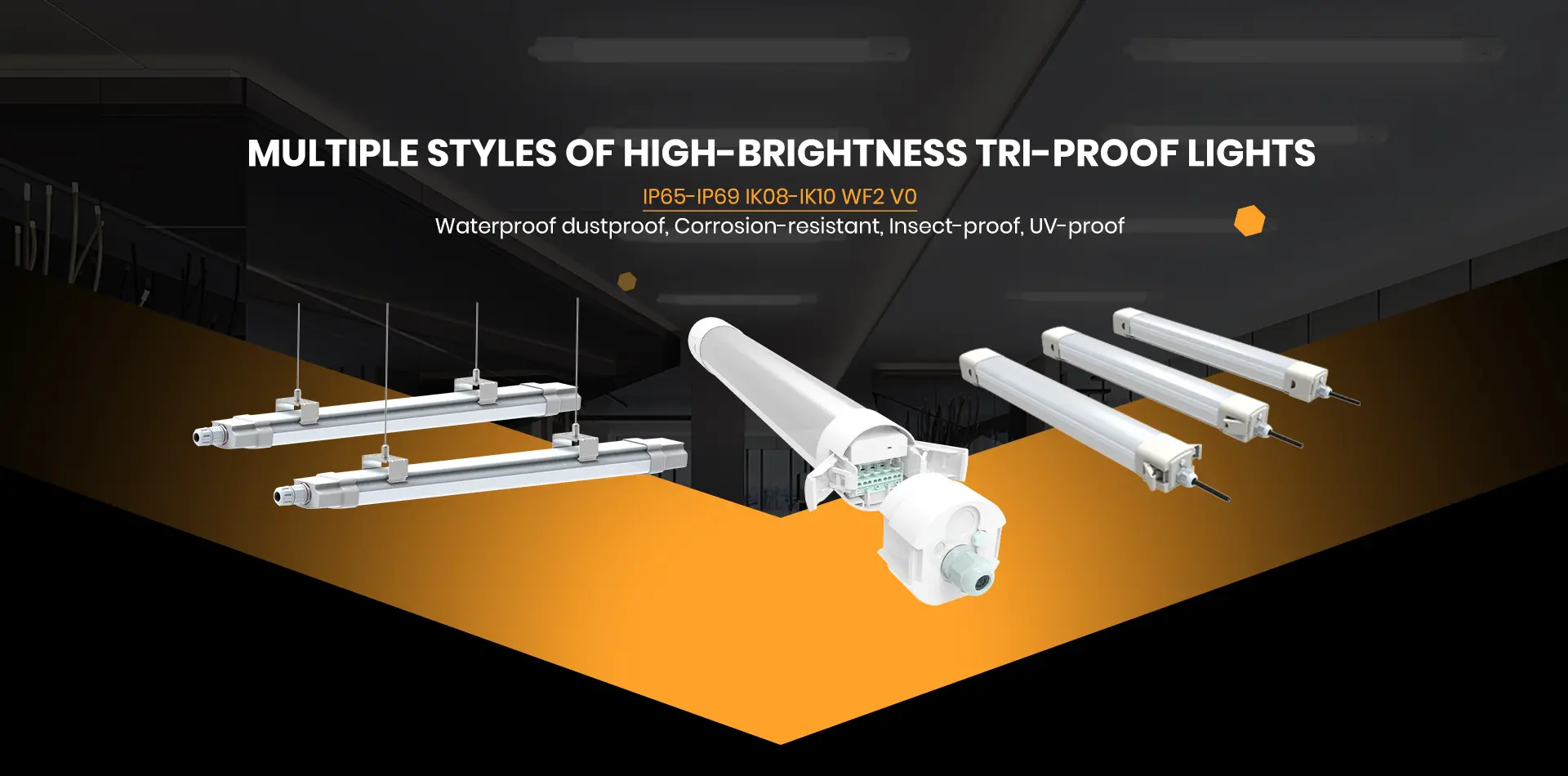
Polycarbonate IP65/IK08 Tri-Proof Batten