
Industrial Sealed & Hazardous Area Luminaires (Top Showcase)
Rigorous in-house IES darkroom tested, 100% aged, and hi-pot verified fixtures engineered for chemical plants, logistics cold-chains, and harsh washdown facilities.


30-50W Rectangular Explosion Proof LED Flood Light


High Lumen 120lm/W Round Mining Explosion Ceiling Light

100W+30W Emergency Backup Explosion Proof LED Lamp

75-300W Compact Explosion Proof Industrial Floodlight

Long Strip LED Explosion Proof Fluorescent Light 20W-60W
Industrial Harsh Environments: The Evolution of Tri-Proof & Explosion-Proof Tube Engineering
Modern manufacturing campuses, petro-refineries, cold storage logistics hubs, and maritime docks operate under punishing environmental stresses. Standard commercial linear battens succumb to ingress degradation within months, causing premature lumen depreciation, catastrophic driver shorting, and severe safety non-compliance.
Tri-Proof Environmental Shielding
Tri-proof luminaires are engineered to withstand three core environmental hazards: water ingress (high-pressure jets and continuous condensation), fine particulate dust penetration, and aggressive chemical corrosion. In food and beverage processing facilities, daily high-pressure washdowns with caustic cleaning agents demand seamless co-extruded polycarbonate or PMMA housings with airtight silicone or expanded EPDM gaskets rated from IP65 to IP69K.
- IP65, IP66, and IP69K certified ingress protection
- Ammonia (NH3) & hydrogen sulfide (H2S) resistance
- Seamless co-extrusion preventing condensation capillary action
Explosion-Proof Hazard Containment
In hazardous industrial zones where volatile hydrocarbon vapors, combustible organic dusts, or explosive gas mixtures are present, standard waterproof sealing is insufficient. Explosion-proof engineering requires flameproof encapsulation (Ex d), increased safety design (Ex e), or encapsulation (Ex m) under IEC 60079 standards. Luminaires prevent internal electrical arcs or component heat from sparking secondary external explosions.
- Zone 1, Zone 2 (Gas) & Zone 21, Zone 22 (Dust)
- Gas groups IIA, IIB, and extreme hydrogen IIC
- Precision thermal dissipation maintaining T5/T6 surface limits
Intelligent Controls & Dynamic Efficiency
Industrial facility managers face escalating kilowatt-hour costs and decarbonization mandates. Modern tri-proof lighting merges ruggedized IP-rated mechanical housings with high-frequency 5.8GHz microwave motion sensors, step-dimming drivers (10%–100%), and daylight harvesting photocells. By dynamically adjusting illumination levels based on automated forklift and personnel detection, energy overhead is slashed by 65% to 82%.
- Microwave sensors penetrating sealed optical diffusers
- 0–10V, PWM, and DALI-2 digital addressable control
- CCT switchable (3000K/4000K/5000K/6500K) field tuning
Navigating the Worldwide Shift Toward Resilient Industrial Solid-State Lighting
The global market for industrial hazardous and tri-proof lighting has crossed $4.8 billion annually, propelled by aggressive factory automation, energy transition infrastructure, and stringent workplace health and safety legislation worldwide.
Procurement teams across North America, Europe, the Middle East, and Southeast Asia are moving rapidly away from legacy fluorescent tubes (T8/T5) and metal halide fixtures. In the European Union, the RoHS Directive ban on mercury-containing fluorescent lamps has triggered widespread linear retrofitting. Meanwhile, in the Middle East and Gulf Cooperation Council (GCC) petrochem sector, extreme ambient temperatures exceeding 50°C paired with corrosive saline air require advanced copper-free aluminum alloy housings with architectural-grade powder coatings.
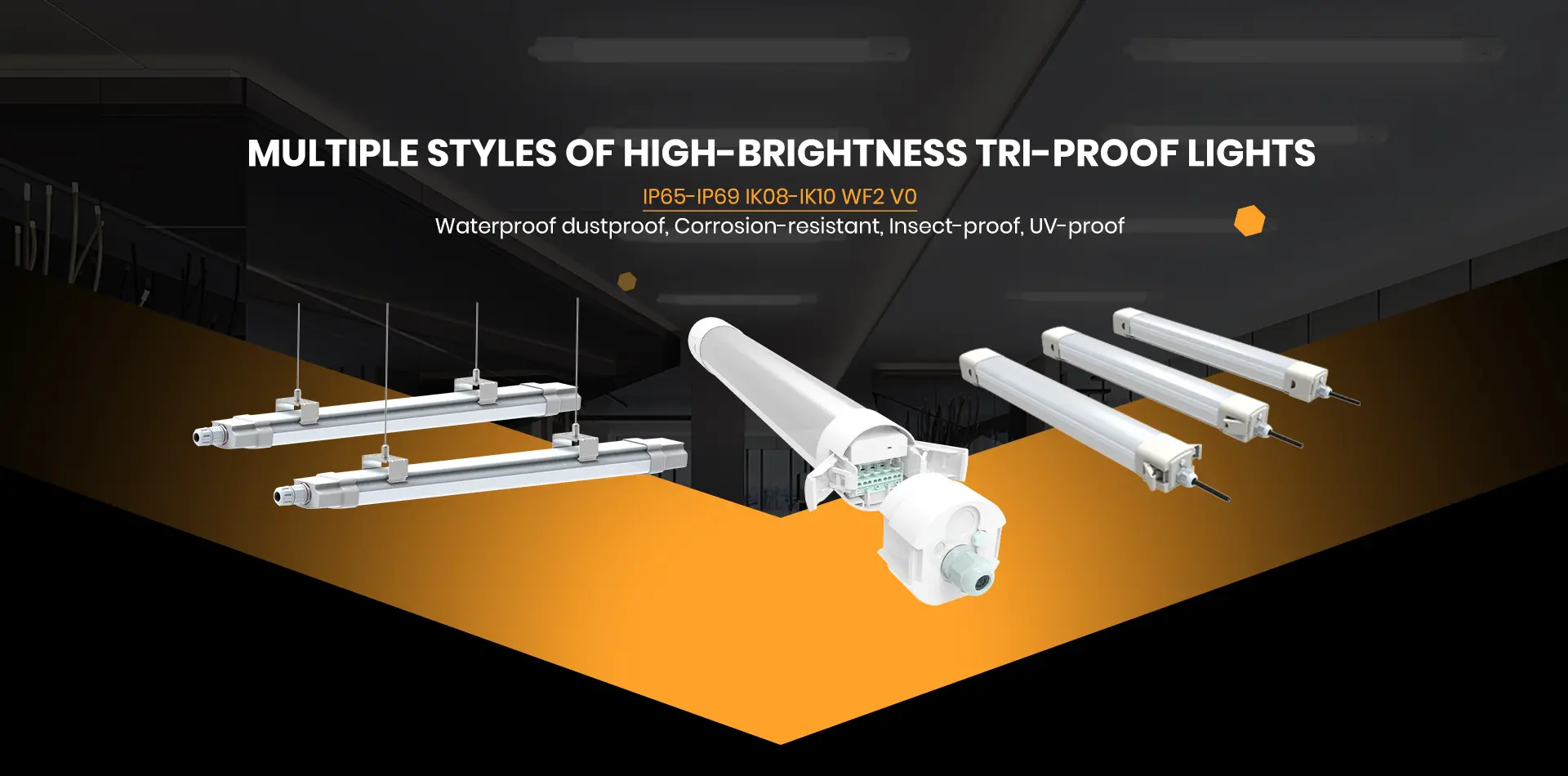
Deep-Dive: Structural Design, Thermal Dissipation & Gasket Polymer Chemistry
Why do cheap tri-proof lights yellow, crack, and fog within 18 months? Long-term industrial durability requires precise chemical compatibility, structural stress dispersion, and advanced silicone polymer cross-linking.
| Component Subsystem | Standard Commercial Grade | Scoden Enterprise Tri-Proof Grade | Explosion-Proof Hazardous Grade | Operational Engineering Benefit |
|---|---|---|---|---|
| Housing Extrusion | Recycled ABS / Polystyrene | 100% Bayer Makrolon UV-Stabilized PC | Die-Cast ADC12 Copper-Free Aluminum | Prevents embrittlement; withstands 5J to 20J mechanical impacts (IK08–IK10). |
| Sealing Gasket | Poured Foam Sponge (Degrades) | One-Piece Continuous Seamless Silicone Ring | Fluororubber / Viton High-Temp Seal | Zero compression set over 50,000 thermal expansion cycles (-30°C to +55°C). |
| LED Driver Topology | Non-isolated, Low PF (<0.85) | Isolated Constant Current, PF >0.97, THD <10% | Potted Dual-Chamber Flameproof Isolated | Protects SMDs from voltage sags, harmonics, and heavy industrial inductive spikes. |
| Optical Diffuser | Thin Single-Wall Extrusion | Frosted Micro-Prismatic PC (Anti-Glare) | 4.0mm High-Borosilicate Tempered Glass | UGR <19 visual comfort; resists severe chemical spray and hot oil splash. |
| Fasteners & Latches | Plastic Clips or Low-Grade Steel | SUS304 / SUS316 Stainless Steel Latches | Hex Socket Captive Stainless Bolts | Absolute corrosion immunity in saline marine, coastal, and chemical fog plants. |
Thermal Management
Oversized internal 6063 aviation aluminum heat sinks ensure LED junction temperatures (Tj) remain strictly under 65°C at 40°C ambient, securing a verified LM-80 lifetime exceeding 60,000 operating hours.
Surge Suppression
Integrated differential-mode 4kV and common-mode 6kV (optional 10kV) lightning arrestors eliminate driver burnout caused by nearby high-tonnage overhead cranes and heavy compressor switching.
Anti-Condensation Breather
Integrated hydrophobic ePTFE pressure valves balance internal and external air pressure, eliminating vacuum suction of moist ambient air during rapid on/off thermal cycling.
Through-Wiring Architecture
Pre-wired through-wiring harness (3x1.5mm² or 5x2.5mm² for dimming/emergency) enables continuous daisy-chain trunking across extensive logistics aisles without additional junction boxes.
Explosion-Proof Classification: Zones, Gas Groups & Temperature Classes
Purchasing lighting for hazardous classified areas requires exact parameter verification. Missing a single environmental classification factor can lead to regulatory shutdowns or catastrophic fires.
1. Zone Classification
Zones define the likelihood and cumulative duration of explosive air-gas or air-dust atmospheres:
- Zone 0 / 20: Continuous explosive hazard (>1,000 hrs/year). Primarily vessel interiors.
- Zone 1 / 21: Likely to occur during standard routine operations (10–1,000 hrs/year).
- Zone 2 / 22: Unlikely to occur; present only during abnormal leaks (<10 hrs/year).
2. Gas & Dust Grouping
Categorizes volatile substances based on Maximum Experimental Safe Gap (MESG) and Minimum Igniting Current (MIC):
- Group IIA: Propane, Gasoline, Methane, Acetone (Least volatile).
- Group IIB: Ethylene, Ethyl Ether, Coal Gas (Medium volatility).
- Group IIC: Hydrogen, Acetylene, Carbon Disulfide (Most volatile; demands highest safety).
- Group III: Combustible flyings (IIIA), non-conductive (IIIB), and conductive dusts (IIIC).
3. Temperature Rating (T-Class)
The maximum external surface temperature developed by any fixture component must not exceed ignition points:
- T1: Max 450°C | T2: Max 300°C
- T3: Max 200°C | T4: Max 135°C
- T5: Max 100°C | T6: Max 85°C (Gold standard safety for petrochem plants).
Targeted Engineering Solutions for Localized Industry Scenarios
Every industry presents unique mechanical and chemical degradation vectors. Here is how custom engineered tri-proof tubes resolve real-world deployment challenges.
Food & Beverage Processing
Requires IP69K smooth tubular profiles without external latches where bacterial colonies or organic debris could accumulate. Polycarbonate diffusers resist hot caustic soda washdowns, high-temperature steam jets, and frequent chemical sanitation cycles.
Cold Storage & Deep Freeze Logistics
Operating down to -40°C causes standard electrolytic capacitors to freeze and seals to shrink. Scoden specialized low-temperature drivers feature aerospace-grade cold-start components and silicone seals that maintain flexibility under extreme freezing conditions.
Chemical Warehouses & Paint Spray Booths
Hazardous flammable solvent aerosols require Zone 1/Zone 2 explosion-proof strip lights. Tempered glass lens construction ensures optical clarity does not cloud when wiped down with organic thinners, acetone, or heavy degreasers.
Underground Parking & Transit Terminals
Continuous exhaust gas particulates (NOx, SOx) paired with 24/7 runtimes mandate IK10 vandal-resistant fixtures with integrated microwave motion sensing, dropping to 20% standby power during zero-occupancy night hours.
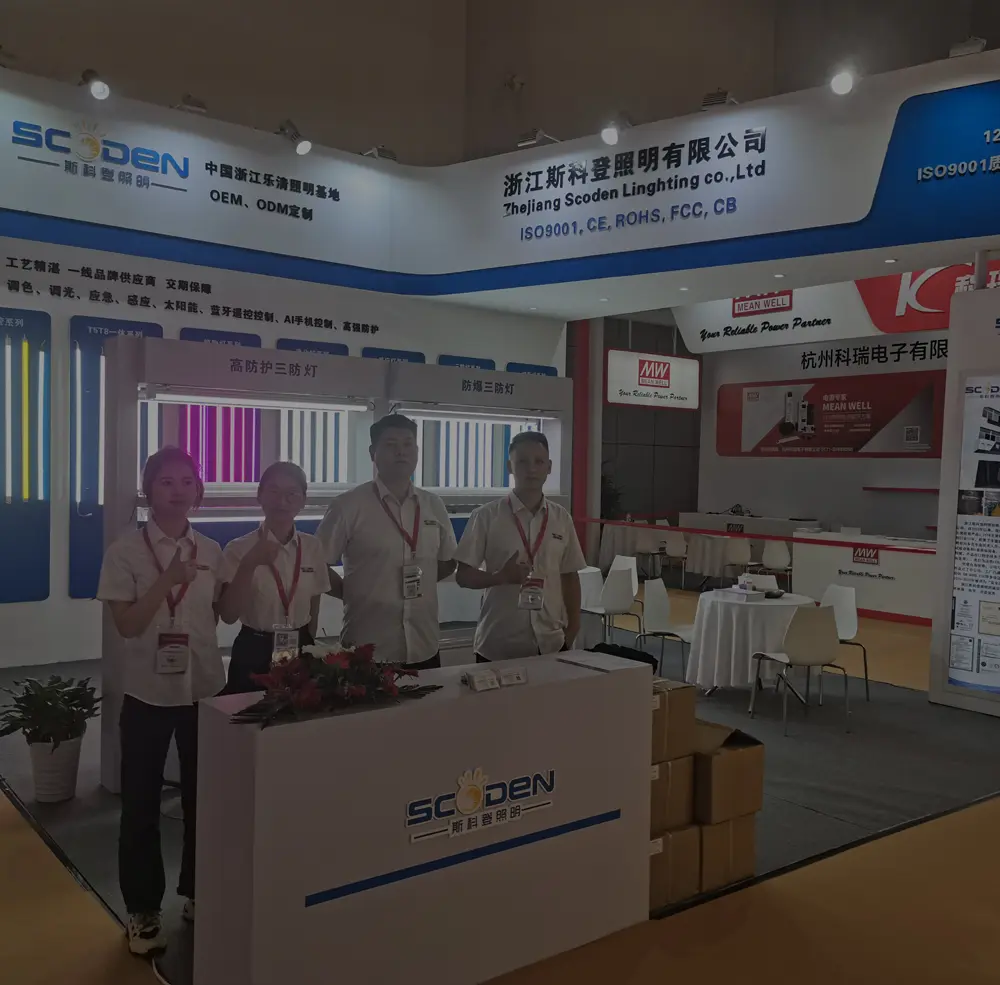
Zhejiang Skodan Lighting: Direct Factory Power, Traceability & In-House IES Testing
Located in Beibaixiang Town, Yueqing City—globally recognized as China’s Electrical Capital—Scoden Lighting operates 2,000m² of integrated production, cleanroom SMT assembly lines, and high-precision testing darkrooms.
Unlike trading companies that rebrand unverified white-label fittings, Scoden directly controls metal stamping, laser marking, automated glue dispensing, automated driver potting, and darkroom goniophotometric validation. Every production lot undergoes a rigorous 4-hour thermal burn-in aging test followed by a 100% withstand-voltage dielectric test (Hi-Pot 3750V) to prevent field dielectric breakdown.
- In-house darkroom providing precise IES and LDT photometric files for DIALux calculations.
- OEM private molding: customized extruded profiles, laser etched logos, and branded box packaging.
- SKD / CKD Supply: knockdown kits for localized assembly to minimize import tariffs for regional partners.
Certificates & Verified Quality Credentials
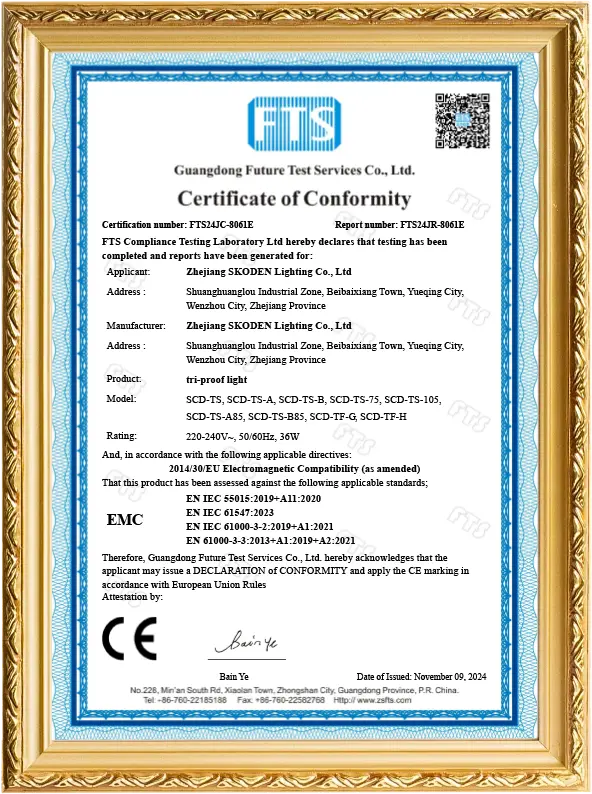
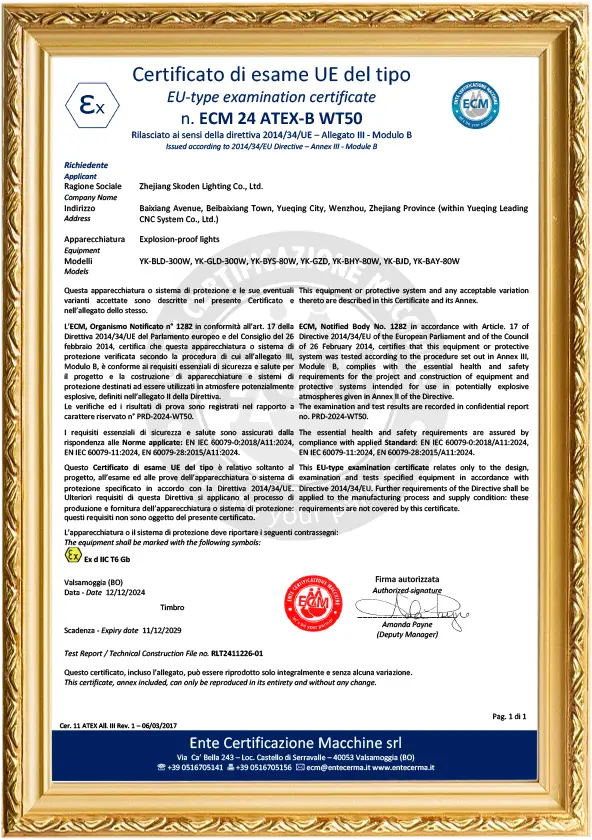
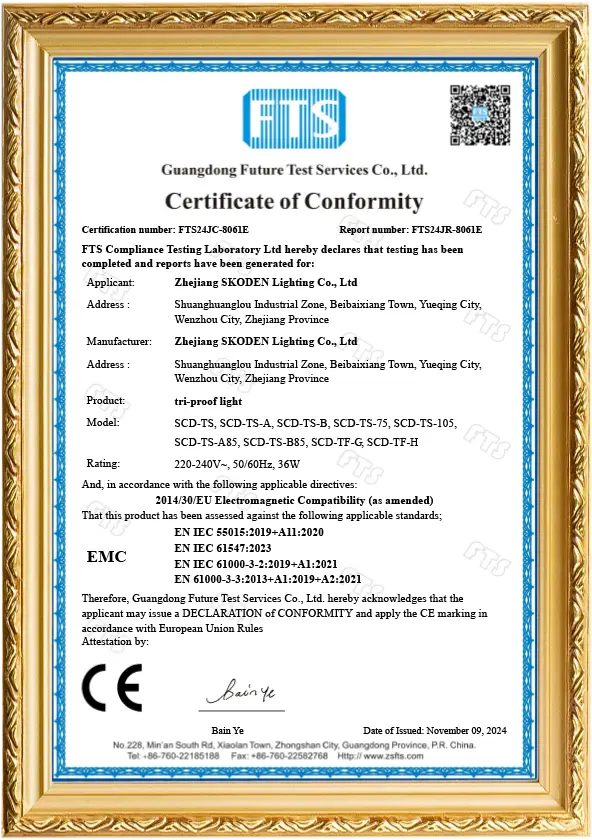
Rigorous compliance you can inspect and verify. Full regulatory packs—including ISO 9001 certificates, CE-LVD, CE-EMC, RoHS documentation, and test reports—accompany project bids.
ISO 9001 Quality System
Certified Factory Management
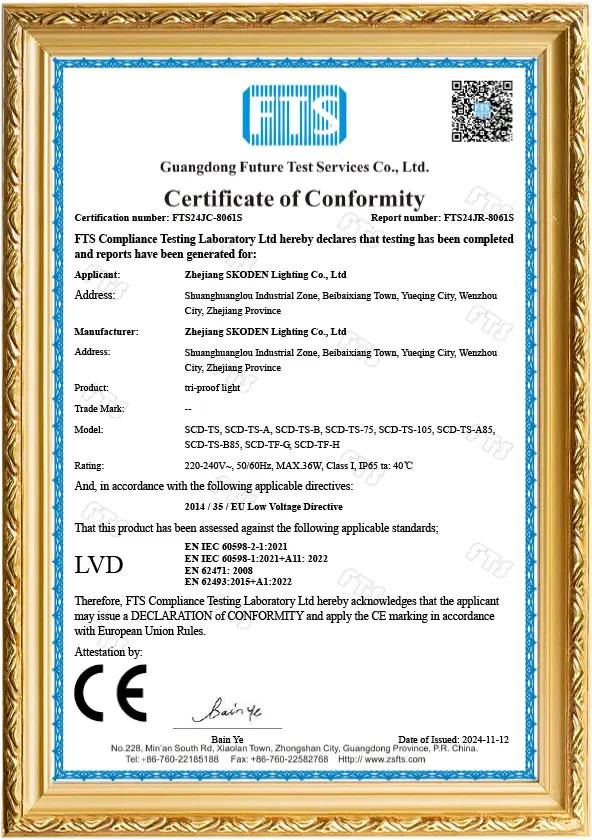
CE-LVD & EMC Certified
European Directives Compliance
IP65 / IP66 Test Records
Independent Laboratory Testing
Photometric IES Testing
Validated Darkroom Output
Technology Roadmap: The Future of Connected Harsh-Environment Lighting
The next decade of industrial lighting extends beyond passive illumination into interconnected IoT sensor matrices, wireless mesh networks, and real-time operational telematics.
Zhaga Book 18 & D4i Ecosystems
Tri-proof fittings are transitioning from hardwired analog sensors to standardized Zhaga Book 18 receptacles. By decoupling the sensor socket from the internal driver, facility managers can hot-swap wireless nodes (Zigbee, Bluetooth Mesh, LoRaWAN) without breaching sealed IP66 chambers or rewiring fixtures.
Predictive Maintenance Telematics
Next-gen intelligent drivers integrate microprocessor telemetry that monitors real-time LED junction temperature, cumulative operating hours, capacitor health, and line-voltage harmonic distortion. Automated alerts flag degrading components weeks before an unexpected operational blackout.
Nano-Ceramic Anti-Fouling Coatings
In heavy industrial sawmills, agricultural grain elevators, and cement handling silos, airborne dust buildup forms an insulating blanket over diffusers, causing thermal runaway. Emerging hydrophobic nano-ceramic surface coatings repel oily dust and electrostatic attraction, reducing manual cleaning cycles.
How Factory Quotes Are Calculated: The B2B Buyer's Sourcing Matrix
Understanding cost drivers allows project engineers and procurement directors to optimize specifications without compromising structural integrity or code compliance.
1. Lumens & SMD Chip Binning
Standard industrial output ranges from 120 lm/W to 140 lm/W utilizing SMD2835. High-efficiency EPC contracts requiring 160 lm/W to 180 lm/W deploy higher chip counts driven at reduced milliamperes, extending component life while marginally increasing initial bill of materials (BOM) cost.
2. Emergency Backup Subsystems
Adding self-contained 90-minute or 180-minute LiFePO4 battery backup modules with automatic periodic self-testing introduces specialized dual-circuit wiring. Selecting smart emergency drivers guarantees fail-safe operation during main grid disconnection.
3. Volume & SKD Packaging
For international distributors with regional assembly capabilities, sourcing in SKD (Semi-Knocked Down) form cuts international ocean freight cube volume by up to 55% while significantly lowering local import duty tariffs compared to fully assembled CBU luminaires.
Frequently Asked Technical & Sourcing Questions (FAQ)
Practical answers directly from our factory engineering, compliance, and export logistics specialists.
What is the fundamental engineering difference between a tri-proof light and an explosion-proof light?
Can Scoden customize linear tri-proof tube wattage, CCT, and wiring configurations?
What testing records and technical documentation are provided with orders?
How do you prevent internal condensation and fogging in cold storage applications?
Where is your factory located, and what is your protocol for on-site or video audits?
Hazardous & Tri-Proof Lighting Series (Bottom Showcase)
Select any model to receive full engineering data sheets, dimensional CAD drawings, and volume factory quotations within 24 hours.

Multi-module Explosion Resistant Flood Lamp 300W 400W

360° Anti-Glare Small Explosion Proof Industrial Light
High Lumen 120lm/W Round Mining Explosion Ceiling Light
100W+30W Emergency Backup Explosion Proof LED Lamp
75-300W Compact Explosion Proof Industrial Floodlight
Long Strip LED Explosion Proof Fluorescent Light 20–60W
Ready to Engineer Your Industrial Lighting Solution?
Submit your site parameters, hazardous zone classification, mounting height, and target lux levels. Our application engineers provide DIALux simulation layouts, verified IES photometric files, and transparent factory-direct pricing within 24 hours.